
11August 2026
If your tile is still in good shape but the grout is cracked, stained, crumbling, or badly discoloured, re-grouting can be a much more affordable option than replacing the entire tile installation.
As an Oakville handyman, I regularly work on shower surrounds, tub surrounds, kitchen backsplashes, entryways, kitchens, and basement floors where the tile itself is still perfectly usable but the grout has reached the end of its life.
For most Oakville homeowners, I would expect a professional re-grouting project to cost roughly $150 to $2,200+, depending heavily on the size of the area, condition of the existing grout, type of tile, accessibility, and whether additional work such as re-caulking or tile repair is required.
For a typical three-wall shower, many homeowners should budget approximately $700 to $1,300 for a proper re-grout, re-caulking, and sealing.
The important thing to understand, however, is that re-grouting is not always the right repair. Sometimes the grout is simply dirty or worn. Other times, failing grout is a warning sign that there is a much bigger problem behind the tile.
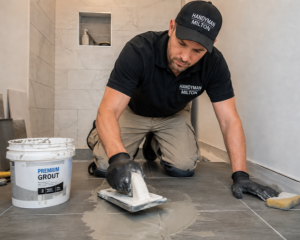
What Does Re-Grouting Existing Tile Cost in Oakville?
There isn’t one price that applies to every re-grouting project. I generally quote these jobs as a fixed project price rather than simply multiplying a square-foot rate.
The reason is that two areas with the same number of square feet can take dramatically different amounts of time.
For example, a simple kitchen backsplash with large rectangular tiles and wide, accessible joints can be relatively straightforward. A shower with small mosaic tiles, niches, corners, a curb, and years of hardened grout can take considerably longer even if the total area isn’t very large.
As a general Oakville pricing guide, these are the ranges I would use:
Shower or tub surround re-grouting
A small shower stall may cost approximately $450 to $900.
A standard three-wall shower or tub surround is often around $600 to $1,500, with many typical projects falling in the $700 to $1,300 range when re-caulking and sealing are included.
Large walk-in or master showers can reach $900 to $2,200 or more, particularly when there are mosaics, niches, natural stone, extensive grout removal, or difficult access.
Kitchen backsplash re-grouting
A small spot repair around a sink or stove may cost approximately $150 to $350.
A complete standard backsplash can typically fall around $350 to $900, depending on the size, tile pattern, grout condition, and amount of removal required.
If the backsplash has intricate mosaics or requires several individual tile repairs, the cost can go higher.
Floor tile re-grouting
Floor re-grouting is often priced based partly on square footage.
For straightforward ceramic or porcelain tile, homeowners might see approximately $5 to $12 per square foot. More difficult projects involving epoxy grout, heavy staining, efflorescence, or extensive preparation can run approximately $8 to $15 per square foot.
A smaller 40- to 60-square-foot entryway or kitchen area might cost around $300 to $700.
A larger 100- to 200-square-foot kitchen or basement floor could be approximately $700 to $2,000 or more, depending on the condition.
I also recommend keeping in mind that many small re-grouting jobs have a minimum service charge. Even if you only need a few feet of grout repaired, there is still time involved in travel, preparation, protecting the work area, removing the damaged grout, installing new grout, cleaning it, and finishing the job.
Colour sealing or grout refresh
Not every grout problem requires removing all of the existing grout.
If the grout is structurally sound but looks dirty, faded, or uneven in colour, a deep cleaning followed by a quality colour sealer can sometimes provide a much better value.
A shower or smaller wet area might cost approximately $250 to $600, while larger floor areas are often priced by square foot.
This can be particularly attractive to Oakville homeowners preparing to sell their home and wanting the bathroom or kitchen to look fresh without paying for a complete re-grout.
What Determines the Cost of Re-Grouting?
The size of the tile area is only one part of the equation.
Amount of old grout that needs to be removed
This is one of the biggest factors.
Re-grouting isn’t simply a matter of putting new grout over the existing grout. The old, damaged material needs to be removed sufficiently so the new grout has a proper surface and enough depth to bond.
A shower where the grout is already loose and falling out can sometimes be easier to prepare than one where the old grout is extremely hard and firmly bonded.
Tile size and pattern
Large-format tiles with relatively simple grout lines can be quicker to work on.
Small tiles, mosaics, hexagons, decorative patterns, and narrow grout joints can require significantly more time because there are many more joints to clean and refill.
Condition of the existing grout
There’s a big difference between grout that is simply discoloured and grout that is powdery, missing, cracked, or contaminated with years of moisture and soap buildup.
If the old grout has failed throughout the installation, I have to spend more time carefully removing it before installing the new material.
Type of grout
The choice between conventional cement-based grout, polymer-modified grout, and epoxy grout can affect the price.
Epoxy can be more expensive to install, but it can make sense in certain wet areas because of its durability and resistance to staining.
I don’t believe homeowners should automatically choose the cheapest grout. The right product depends on the tile, joint size, location, expected use, and condition of the installation.
Re-caulking
Showers and tubs have areas where different surfaces meet, such as wall-to-wall corners and wall-to-tub joints.
Those areas generally should not simply be treated like ordinary grout joints.
If the existing caulk has failed, I will often recommend removing it and re-caulking those joints as part of the project.
That adds to the cost, but it is often an important part of doing the job properly.
Tile repairs
Sometimes removing old grout exposes a loose or damaged tile.
If a tile needs to be removed and replaced, the project can become more involved. This is another reason I prefer inspecting the area before giving a final quote.
My Most Common Re-Grouting Jobs in Oakville
From my experience working in Oakville homes, showers and tub surrounds generate the most re-grouting requests.
Shower and tub surrounds
These are easily the most common.
Constant moisture, soap residue, cleaning products, and years of use can take a toll on grout. I see this particularly in older condos and townhomes where bathroom installations may now be 10, 15, or even 20 years old.
A typical project might involve:
- Removing damaged grout
- Cleaning and preparing the joints
- Installing new grout
- Re-caulking corners and tub joints
- Cleaning the tile
- Applying an appropriate sealer where applicable
Kitchen backsplashes
Kitchen backsplashes are another common request.
Grease, cooking residue, water around the sink, and frequent cleaning can leave grout looking tired.
Sometimes the homeowner only needs a few damaged areas repaired. Other times, a complete re-grout makes sense, particularly when they have recently purchased the home or are preparing it for sale.
Entryways, kitchens, and basement floors
Floor grout has its own challenges.
Oakville winters bring salt, sand, dirt, and melting snow into entryways. High-traffic floors can gradually wear down grout.
Basement floors can have different problems, including moisture and efflorescence, which can cause grout to deteriorate.
In these situations, I may recommend a combination of re-grouting, sealing, and replacing a few broken tiles rather than treating the grout problem in isolation.
Should You Re-Grout or Just Clean and Seal?
One of the mistakes homeowners make is assuming that dirty-looking grout automatically needs to be removed.
Sometimes it doesn’t.
My first question is whether the grout is actually structurally sound.
Clean and seal when the grout is still solid
I would generally consider cleaning and sealing when:
- The grout is intact.
- It isn’t crumbling or falling out.
- The primary problem is staining or discolouration.
- The tiles are firmly attached.
- There are no obvious signs of moisture behind the installation.
If the grout is simply dirty but otherwise healthy, spending money on complete removal may be unnecessary.
In a shower, I generally advise homeowners to inspect the condition of their grout and sealant regularly. Depending on usage and the product, resealing may be appropriate every one to two years.
Spot repair when only a few areas have failed
If only several joints are cracked or missing and the surrounding grout is solid, I don’t automatically recommend a complete re-grout.
I may remove the damaged sections, repair those joints, blend the colour as closely as possible, and then seal the area where appropriate.
This is particularly common around corners, niches, fixtures, and other high-stress areas.
Full re-grout when the problem is widespread
A full re-grout makes sense when the grout is failing throughout the installation but the tile and substrate are still in good condition.
Typical warning signs include:
- Widespread crumbling
- Powdery grout
- Missing grout
- Persistent staining
- Multiple cracked joints
- Grout that has become extremely porous
- Older installations where the grout is generally deteriorated
In that situation, removing the old grout and installing new grout can give the entire installation a significant functional and cosmetic refresh without replacing perfectly good tile.
When Re-Grouting Is the Wrong Solution
This is probably the most important advice I can give homeowners considering a re-grouting project.
Grout cannot fix a damaged substrate or failed waterproofing system.
If the problem is behind the tile, putting new grout on the surface is not a permanent solution.
I look for several warning signs before recommending a full re-grout.
Hollow or loose tiles
If tiles sound hollow when tapped or move when pressed, I want to know why before proceeding.
It could indicate a bonding problem or a compromised substrate.
Persistent musty smells
A musty smell around a shower that doesn’t disappear after cleaning can be a warning sign of moisture where it shouldn’t be.
Water stains outside the shower
Peeling paint, bubbling drywall, staining, or damage on the other side of the bathroom wall or on the ceiling below deserves investigation.
Soft substrate
If the wall or floor around the shower feels soft or damaged, new grout isn’t going to solve the underlying problem.
Recurring mold
If mold keeps coming back shortly after cleaning, particularly when accompanied by other moisture-related symptoms, I don’t automatically blame the grout.
These are situations where I may recommend opening up a small area for inspection or bringing in the appropriate specialist before proceeding.
A Real Oakville Re-Grouting Job That Became a Much Bigger Repair
One of the most memorable re-grouting jobs I’ve handled was a second-floor shower in an older Oakville townhome near Third Line and Dundas.
The homeowner initially called it a cosmetic job.
The shower was approximately 10 to 12 years old. The grout was dark and stained, there were cracks around some corners, and the caulk at the tub-to-wall joint had failed.
The original request was straightforward: remove the old grout, re-grout, re-caulk, and seal.
That type of project would normally be in the range of roughly $700 to $1,100 depending on the exact condition and size.
But once I started removing the old grout, I noticed things that didn’t look right.
What I discovered
Some of the tiles near the bottom corners sounded hollow when tapped.
After carefully removing a couple of loose tiles, I found soft, water-damaged wall material and visible mold growth behind the shower wall.
There was also a musty smell that shouldn’t have been there.
At that point, continuing with a simple re-grout would have been the wrong thing to do.
The problem wasn’t simply old grout. There had been moisture getting behind the tile for a long time.
Why I changed the recommendation
I explained to the homeowner that new grout would only cover up the symptoms.
The proper repair involved removing the affected tile and damaged wall sections, addressing the moisture and mold issue appropriately, replacing the damaged substrate, installing a proper waterproofing system, and then rebuilding the tile surface.
The project went from what could have been an approximately $800 to $1,000 re-grout into a multi-thousand-dollar shower repair.
Nobody likes hearing that their project is more expensive than expected.
But I would much rather tell a homeowner the truth when I find the problem than install new grout over damaged material and have them call me back six months later with an even bigger problem.
That experience reinforced one of my biggest rules when it comes to re-grouting:
If the damage is behind the tile, no amount of surface re-grouting will solve it.
The Biggest Mistake Homeowners Make Trying to Save Money
The biggest false economy I see is trying to use a cheap re-grout to solve a waterproofing or substrate problem.
It can be tempting.
A homeowner sees cracked or mouldy grout and thinks, “I’ll just replace the grout.”
But if moisture has already reached the wall assembly, the new grout doesn’t repair what’s underneath.
The homeowner may spend a few hundred dollars, enjoy the improved appearance for a while, and then discover that:
- Mold comes back.
- Grout cracks again.
- Tiles become loose.
- Moisture stains appear.
- The substrate continues deteriorating.
Eventually, the homeowner may need to pay for the re-grout again and then pay for the actual underlying repair.
That’s how a job that should have been diagnosed properly from the beginning becomes much more expensive.
Other Re-Grouting Mistakes I See
Waterproofing isn’t the only issue.
Not removing enough old grout
New grout needs an appropriate amount of prepared joint to bond properly.
Simply scraping a little material out of the surface and putting new grout over it can result in premature failure.
Choosing the wrong grout
Not every grout is appropriate for every application.
The tile type, joint width, location, moisture exposure, and expected use all matter when selecting the product.
Skipping preparation
A good-looking finished grout job starts with proper preparation.
The joints need to be properly cleaned and prepared before the new grout goes in.
Rushing the curing process
Grout needs time to cure properly.
Using a shower too soon, mixing the material incorrectly, or rushing the cleaning process can compromise the finished result.
How I Decide What a Homeowner Actually Needs
When I inspect a re-grouting job in Oakville, I generally reduce the decision to three questions.
Is the grout structurally sound or simply dirty?
Is the problem isolated or widespread?
Is there any evidence that water is getting behind the tile?
Those three questions usually point me toward the appropriate repair.
Dirty but solid
Clean and seal.
A few damaged joints
Spot repair and seal.
Widespread crumbling or cracked grout with solid tiles
Full re-grout.
Hollow tiles, musty odours, soft substrate, recurring mold, or moisture stains
Stop treating it as a grout problem and investigate the underlying waterproofing or substrate.
This approach helps homeowners avoid paying for work they don’t actually need while also preventing them from spending money on a cosmetic fix that won’t last.
How Much Should You Budget for Re-Grouting?
For a rough Oakville planning budget, I would use these figures:
- Small shower refresh: approximately $500–$800
- Typical three-wall shower re-grout: approximately $750–$1,300
- Large or complicated shower: approximately $900–$2,200+
- Kitchen backsplash: approximately $400–$900
- Small floor re-grouting project: approximately $350–$700
- Colour-sealing/grout refresh: approximately $250–$600
- Major waterproofing or substrate repair: potentially several thousand dollars depending on the extent of damage
These are planning ranges rather than guaranteed quotes. The actual price depends on what I find when I inspect the tile, grout, substrate, access, and overall condition.
Is Re-Grouting Worth the Money?
When the tile and substrate are still sound, absolutely.
A properly executed re-grout can dramatically improve the appearance of an older bathroom, kitchen, entryway, or basement floor without the cost and disruption of replacing the tile.
But I don’t recommend re-grouting simply because it appears to be the cheapest option.
The cheapest repair today isn’t necessarily the cheapest repair over the next five or ten years.
If the grout is simply stained, clean and seal it.
If a few joints are damaged, repair those areas.
If the grout is failing throughout but everything underneath is healthy, re-grout the area properly.
And if there are signs of water damage behind the tile, address that problem first.
That’s the approach I use on my Oakville jobs because my goal isn’t just to make the tile look better when I leave. I want the repair to make sense for the condition of the home and give the homeowner a solution that is worth paying for.
If you need help with tile and grout work, contact us today to discuss your project and get a free quote.