
10July 2026
Most fence problems don’t start with a broken board – they start underground, at the posts, quietly getting worse through winter after winter. As someone who regularly repairs and troubleshoots residential fences in Canadian climates like Hamilton, I see the same pattern over and over: homeowners focus on cosmetics while the real structural issues go unnoticed until the fence is on the verge of failure.
This post is written from that hands-on perspective. I’m not just talking about fences in theory. I’m going to walk you through real problems I’ve seen, the fixes that actually work, and the specific signs that tell you it’s time to call a professional instead of trying to patch things yourself.
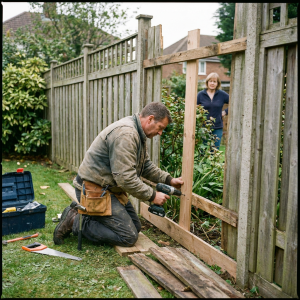
Canadian Fence Reality: Why Our Fences Fail Faster
In Southern Ontario, fences don’t live in “ideal” conditions. They deal with:
-
Freeze–thaw cycles that expand and contract soil.
-
Frost heave that slowly pushes posts out of alignment.
-
Heavy snow loads that add weight and stress.
-
Moisture that sits at ground level and feeds rot.
-
Strong winds that push against panels and gates.
These aren’t minor issues. Over time, they act like a slow-motion wrecking ball on your fence’s foundation. A fence can look fine above ground while its posts are quietly tilting, rotting, or lifting out of the soil one winter at a time.
That’s why I put so much emphasis on proper post depth, correct concrete work, drainage, and material choice. If those aren’t right, no amount of nice stain or new boards will save the fence in the long run.
Case Study: The Leaning Privacy Fence That Didn’t Need Full Replacement
One project that sticks with me involved a wood privacy fence that was leaning badly after several winters. The homeowner was convinced the posts were rotten and that the entire fence had to go.
What I Found During Inspection
When I inspected the fence, the story was different than what it looked like at first glance:
-
Most of the posts were still structurally sound.
-
The real problem was that many posts had been set too shallow for local freeze–thaw conditions.
-
Frost heave had gradually pushed those posts out of alignment, pulling the entire fence out of square.
In other words, the fence wasn’t failing because the boards were old. It was failing because the posts weren’t deep enough to deal with our climate.
How We Fixed It
Instead of tearing everything out, we:
-
Identified and replaced only the affected posts.
-
Set the new posts below the frost line.
-
Re-squared and reinforced the sections that had shifted.
The result was a sturdy, straight fence without the cost of a total replacement.
What Homeowners Usually Miss
Most homeowners focus on what they can see: the panels, the rails, the finish. The lesson from this project is simple:
-
The real strength of a fence comes from what’s happening underground.
-
If posts aren’t installed correctly from the start, problems will show up years later even if the visible wood still looks “fine”.
-
A leaning fence doesn’t automatically mean full replacement – but it does mean you need someone who understands post depth and frost heave.
Case Study: The “Hardware Problem” Gate That Was Really a Post Problem
Another memorable project involved a gate that constantly sagged and refused to latch properly. The homeowner had already replaced the hinges more than once, convinced the hardware was defective.
The Real Issue Behind the Sagging Gate
When I took a closer look, the pattern was familiar:
-
The gate opening had shifted.
-
One of the supporting posts was slowly leaning.
-
As that post moved, the gate frame followed, throwing everything out of alignment.
It wasn’t a hinge problem. It was a structural problem disguised as a hardware issue.
The Right Fix
To solve it properly, we:
-
Reset the leaning support post.
-
Adjusted and squared the gate frame.
-
Installed proper bracing to handle the extra stress a gate always creates.
Once the structure was solid, the hardware started doing its job – and stayed that way.
The Hidden Truth About Gates
Here’s something many homeowners don’t realize:
-
A gate puts far more stress on a fence post than a regular panel.
-
A gate can seem fine for the first year or two, but if the supporting post is undersized, poorly anchored, or exposed to excess moisture, problems will eventually show up.
-
Replacing hinges over and over is usually a symptom of a deeper issue, not the solution.
My Red-Flag Signs: When Your Fence Needs a Professional Repair (Not Just DIY)
When I walk a property, I’m not just looking at how the fence “looks.” I’m asking one main question: is this a cosmetic issue, or is the structure in trouble?
Structural Red Flags That Call for a Pro
These are the signs that tell me a professional repair is the smarter, safer move:
-
Posts that are significantly leaning or wobbling when pushed.
-
Posts that have heaved up from frost or sit unevenly in the ground.
-
Cracked or badly rotted posts, especially at ground level.
-
Multiple sections leaning at the same time.
-
Storm or impact damage that has clearly shifted the structure.
-
Gates that are pulling support posts out of alignment.
-
Any sign the fence is no longer straight, plumb, or square.
When you see these issues, you’re usually dealing with:
-
Digging and concrete work.
-
Post replacement and proper depth below the frost line.
-
Realignment of rails and panels.
Those jobs go beyond casual DIY. They need tools, experience, and an understanding of how a fence should carry load and resist our climate.
Issues That Are Usually Fine for DIY
On the other hand, there are plenty of problems homeowners can handle themselves if they’re comfortable with basic tools:
-
Replacing a few damaged pickets or boards.
-
Tightening loose screws, brackets, and fasteners.
-
Adjusting gate hardware when the posts are rock-solid.
-
Cleaning off mildew or dirt.
-
Sanding and applying stain or sealant.
-
Replacing minor trim pieces that don’t affect structure.
My general rule is simple:
-
If the problem affects structural support, stability, or alignment, treat it as a professional repair.
-
If it’s mostly cosmetic and doesn’t disturb the main structure, it’s a good candidate for DIY maintenance.
Hamilton Reality: When You Must Stop Patching and Call a Professional
In Canadian cities like Hamilton, there are situations where continuing to patch your fence is not just a waste of money – it can create safety risks, neighbour disputes, and compliance headaches.
When Structural Soundness Is Gone
If your fence is no longer structurally sound, it’s time to stop treating it as a DIY project. That includes:
-
Multiple leaning or loose posts.
-
Sections that are collapsing or moving in the wind.
-
Gates that are pulling posts out of position.
-
Rot that has reached the main structural components, not just surface boards.
At that point, replacing a board here and there is just delaying the inevitable and potentially setting yourself up for a failure in a high wind or heavy snow.
When Property Lines and Neighbours Are Involved
Any fence that’s close to a property line deserves careful, professional attention when major repairs are needed. I’ve seen how quickly a simple replacement can turn into a dispute when:
-
The fence is rebuilt a few inches in the wrong direction.
-
Old, unclear boundaries are assumed instead of verified.
-
One owner makes changes without considering the other.
The cost of correcting a property-line mistake – legally and physically – can be far higher than just hiring someone who will verify boundaries and plan the repair properly from the start.
When Local Bylaws and Safety Standards Matter
Hamilton and other municipalities have rules about:
-
Fence height.
-
Visibility near driveways and corners.
-
Pool enclosure standards.
-
Safety around certain types of properties.
If a repair or modification could affect any of these, it’s smart to get professional guidance. Many homeowners fix the visible problem without realizing they have stepped outside compliance, which can bring trouble later.
When Gates and Posts Keep “Moving”
Another non-negotiable for me: if a gate no longer closes properly because the supporting post is moving, stop adjusting the latch and hinges.
-
A shifting post is a symptom of a larger structural issue.
-
Continuing to tinker with hardware just hides the problem while the post moves further and stresses the entire section.
When Curb Appeal and Value Take a Hit
From a property-value standpoint, I often advise homeowners to stop patching when repairs become obvious from the street:
-
Mismatched boards everywhere.
-
Multiple reinforcement brackets and temporary fixes.
-
Panels clearly out of line or leaning.
At some point, a clean, proper repair or replacement adds more value than another round of patches.
Why Fence Failures Start Long Before They’re Visible
One of the biggest takeaways from my projects is this: fence failures usually start long before the average homeowner notices anything.
By the time a fence is:
-
Visibly leaning.
-
Clearly sagging.
-
Separating at joints and corners.
The underlying issue has often been developing for years. Small movements each winter, a little rot at ground level, a gate post slowly settling – all of that adds up.
That’s why I keep emphasizing regular inspection and paying attention to signs that seem minor. In our climate, “minor” doesn’t stay minor forever.
What I Want Homeowners to Do Differently
If you’re a homeowner in Hamilton or a similar Canadian city, here’s how I’d like you to change the way you look at your fence.
Stop Treating Fence Problems as Purely Cosmetic
Loose boards, peeling stain, and a gate that won’t latch are often the first thing you notice. But I want you to ask:
-
Is this just a surface issue?
-
Or is it a warning sign of deeper movement, rot, or frost damage?
Appearance can be misleading:
-
A fence with faded wood or a few damaged boards can still be structurally sound.
-
A fence that looks “okay” from a distance may actually be shifting at the posts.
Start Doing Proactive Seasonal Inspections
Especially after winter and major storms, make it a habit to:
-
Check for leaning or wobbling posts.
-
Look for soil movement or gaps at post bases.
-
Inspect for rot at ground level.
-
Test gate alignment and watch for sagging or binding.
-
Tighten visibly loose hardware.
These quick checks help you catch problems when they’re still small and cheaper to fix.
Know When to DIY and When to Call a Pro
In practical terms:
-
Handle simple, non-structural tasks yourself: cleaning, staining, board replacement, basic hardware adjustments.
-
Call a professional when you see movement at posts, multiple leaning sections, gate-related structural stress, or anything that might affect property lines or bylaws.
Avoid two big mistakes I see all the time:
-
Repeatedly spending money on temporary fixes when the fence’s structural components are already failing.
-
Assuming every problem means the whole fence must be replaced.
In many cases, targeted professional repairs done at the right time can extend the life of your fence and save thousands.
How I Want My Advice to Come Across
My goal isn’t to scare you into replacing your fence or push you toward unnecessary work. I want to come across as a practical, experienced handyman who has seen these problems firsthand and can help you:
-
Understand what warning signs really matter.
-
Decide whether a repair is worth it or replacement is the smarter investment.
-
Protect your fence from the unique challenges of Canadian weather.
If you finish this article feeling more confident about assessing your own fence, knowing the signs that call for professional help, and catching issues before they become costly headaches, then it’s done its job.
Your fence is more than a line of boards – it’s a structure dealing with real forces underground and in the air. Respect that, and you’ll get more life and value out of it.
One Reply to “Signs Your Fence Needs Professional Repair”