
24August 2026
If you’re a homeowner in Oakville, Mississauga, Brampton, or anywhere across the GTA, you’ve probably heard the debate: seamless gutters vs. sectional gutters. Contractors might push one or the other. Online articles give generic pros and cons. But here’s the truth I’ve learned after years of inspecting, repairing, and replacing gutters on hundreds of local homes: the best choice depends far more on your home’s specific condition than on which type of gutter sounds fancier.
I’m not here to sell you on seamless gutters because they’re “premium.” I’m here to help you make a smart, long-term decision based on what actually matters, how water moves off your roof, how your system is installed, and whether you’re solving the real problem or just patching symptoms.
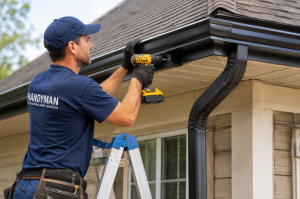
The Most Common Gutter Problem I See in the GTA (It’s Not What You Think)
From my perspective as an Oakville handyman, the single most common gutter-related issue I encounter isn’t caused by the type of gutter, it’s poor drainage. Specifically, clogged, undersized, or improperly pitched gutters and downspouts that can’t handle the volume of water coming off the roof.
In older GTA homes, especially in neighborhoods with mature trees like Bronte, Old Oakville, or parts of Mississauga near the Credit River, I often see gutters overflowing at the corners or during heavy summer storms. The culprit? Water isn’t getting to the downspouts efficiently.
Does the choice between seamless and sectional gutters cause this? Rarely. I’d estimate it’s responsible for maybe 20–30% of the problems I see. Seamless gutters have fewer joints, so yes, there are fewer places for leaks to develop. But they can still overflow if the slope is wrong, the downspouts are too small, or the installation is sloppy. Sectional gutters, when installed properly, can work perfectly well for decades. Their main weakness is that the seams create additional potential leak points over time.
Here’s what I tell every homeowner: installation quality matters more than whether your gutters are seamless or sectional. A properly pitched sectional system with adequate downspouts will outperform a poorly installed seamless system every single time.
A Real Oakville Case Study: When Seamless Made Sense (and When It Didn’t)
One example that stands out was an older two-storey home in the Bronte area of Oakville, built in the late 1980s. The house had the original sectional aluminum gutters, and the homeowner had kept them because they were still generally in decent shape. Replacing the entire system hadn’t seemed necessary.
Over the years, though, the seams had become the weak point. There were several small leaks at the joints, and during heavier rain, the gutters were also overflowing near one corner. The homeowner had already paid for a couple of small repairs, so they were starting to spend money repeatedly without really solving the underlying problem.
When I inspected it, the gutters themselves weren’t completely worn out. The bigger issue was a combination of seam failures, poor pitch in a couple of sections, and inadequate downspout positioning. Rather than simply resealing everything again, I recommended replacing the problem runs with new seamless aluminum gutters, adding a larger downspout where the water volume warranted it, and correcting the pitch.
The seamless system cost more upfront than repairing the existing sectional gutters, but it eliminated most of the joints, the places where they had been having recurring leaks. In that situation, I felt the replacement made more financial sense than continuing to pay for small repairs every few years.
That experience is why I don’t tell Oakville homeowners that seamless is automatically better. Sectional gutters can last for many years when they’re installed and maintained properly. But if you’re dealing with an older system where the seams are repeatedly leaking, the fascia is still sound, and you’re already paying for repairs, that’s when I would seriously consider replacing those sections with seamless aluminum rather than continuing to patch them.
3 Big Myths About Seamless vs. Sectional Gutters (Debunked)
From my perspective as an Oakville handyman, I hear a few misconceptions pretty regularly when homeowners are comparing seamless and sectional gutters. Here are the top three, and how I correct them in every consultation.
Myth #1: “Seamless Gutters Never Leak”
I explain that seamless simply means the long runs are made without horizontal joints, so there are fewer potential leak points. But you can still get leaks around corners, end caps, outlets, and downspout connections. Poor installation, movement, or damaged fascia can also create problems. So seamless reduces one common source of leaks, it doesn’t make the system leak-proof.
Myth #2: “Sectional Gutters Are Always Cheaper”
They can be less expensive upfront, particularly for a small repair or a simple installation, but I tell homeowners to look at the long-term cost as well. Sectional systems have more joints, and those joints can eventually require resealing or repair. If I’m seeing an older sectional system with repeated seam leaks, spending money on another patch may not be the best value.
Myth #3: “Choosing Seamless Means You Have to Replace the Entire Gutter System”
That’s not necessarily true. If most of the existing system is in good condition, we can often replace specific runs, corners, or downspouts rather than tearing everything out. I always inspect the gutters, pitch, fascia, hangers, and drainage before recommending a full replacement.
My general approach in a consultation is to look at the actual condition of the system rather than sell the homeowner on one type of gutter. I explain where the problem is, what is causing it, and whether a repair, partial replacement, or complete replacement makes the most sense. In my experience, that’s a much better way to make the seamless-versus-sectional decision.
The 3 Installation Factors That Matter More Than Gutter Type
From an Oakville handyman’s perspective, I’d say there are three things that matter far more to gutter performance than whether the system is seamless or sectional.
1. Proper Pitch and Water Flow
This is probably the first thing I check. A gutter can look perfectly installed but still perform poorly if it doesn’t have enough slope toward the downspout, or if it has developed a low spot where water sits. In Oakville, where we can get very heavy summer storms as well as snow and ice in the winter, I want to see water moving efficiently rather than pooling in the gutter. I also check that the fascia and gutter line are straight enough to maintain that pitch over the entire run.
2. Downspout Sizing, Placement, and Drainage
I’ve seen plenty of gutter problems where the gutter itself wasn’t the issue, the system simply couldn’t move the amount of water coming off the roof. Too few downspouts, undersized downspouts, or downspouts discharging too close to the foundation can create overflow and basement or foundation problems. I look at the roof area being served, where the downspouts are located, and whether the extensions actually move water far enough away from the house.
3. The Condition of the Fascia and How the Gutters Are Attached
This is one I wish homeowners and contractors paid more attention to. A new gutter installed onto rotten or deteriorating fascia isn’t really a proper repair. I check the wood behind the gutter, the condition of the soffit and fascia, and whether the hangers are properly supporting the gutter. Hanger spacing matters too, particularly on longer runs where snow and ice can add significant weight.
So when I’m assessing a gutter system, I don’t start by asking “seamless or sectional?” I start with “Where is the water supposed to go, and can the entire system reliably get it there?” If the pitch, drainage capacity, and structural support are right, either gutter type can perform well. If those fundamentals are wrong, even an expensive seamless system can give the homeowner problems.
Your Driveway Checklist: How to Decide Between Seamless and Sectional Gutters Today
If I were giving a GTA homeowner one practical piece of advice, I’d tell them: don’t choose seamless or sectional first, diagnose the existing system first. You can do a surprisingly good initial assessment from the driveway.
Here’s my simple gutter decision checklist:
-
Watch the gutters during the next decent rainfall. Look for water overflowing over the front edge, especially at corners. Also watch whether water is sitting in sections of the gutter after the rain stops. Standing water is a sign the pitch may be wrong.
-
Look closely at the seams and corners. If you have sectional gutters, check the joints for staining, drips, separated seams, or previous caulking repairs. If you’re seeing multiple repaired joints, that’s a good reason to consider seamless when replacement becomes necessary.
-
Check the downspouts. Count them and look at where they discharge. During heavy rain, see whether water is backing up or overflowing before reaching the downspout. Make sure extensions direct water away from the foundation rather than dumping it right beside the house.
-
Check the gutter line from the ground. Look for sagging, bowing, loose sections, or obvious low spots. If the gutter is pulling away from the fascia, don’t assume new gutters alone will solve the problem, the underlying fascia and attachment points need to be inspected.
-
Make the decision based on what you find:
-
Gutters are straight, draining properly, and have only one minor leak: repair the existing system. Don’t replace it just because it’s sectional.
-
Sectional gutters have multiple leaking seams or recurring repairs: get a quote for seamless replacement and compare the long-term cost.
-
Gutters are sagging, overflowing, or draining poorly: fix the pitch, downspouts, and structural issues before worrying about gutter type.
-
Fascia is rotten or damaged: address that first. New gutters attached to bad wood won’t solve the underlying problem.
-
Most of the system is sound but one run is failing: ask about replacing only that run rather than automatically replacing the entire house.
-
My biggest advice to GTA homeowners is: don’t let a contractor make the seamless-versus-sectional decision for you before they’ve explained why your existing system is failing. A good gutter installation is really about managing water from the roof all the way to where it safely leaves the property. The gutter material is only one part of that system.
Final Thoughts: Choose the Solution, Not Just the Product
At the end of the day, whether you go with seamless or sectional gutters should be a decision based on your home’s specific needs—not marketing hype or a contractor’s default recommendation. In the GTA, where weather can be unpredictable and older homes are common, the smartest approach is to focus on the entire system: pitch, downspouts, fascia, drainage, and yes, the gutter type.
If you’re in Oakville, Mississauga, Brampton, or nearby and you’re unsure whether your gutters need repair, partial replacement, or a full upgrade, start with a thorough inspection. Look at how water moves, where it pools, and what’s really causing the problem. Then, and only then, decide whether seamless or sectional makes the most sense for your situation.
Because in my experience, the best gutter system isn’t the one that sounds the most impressive—it’s the one that keeps your foundation dry, your basement safe, and your home protected for years to come.